



How Much Does a Gallon of Water Weigh?
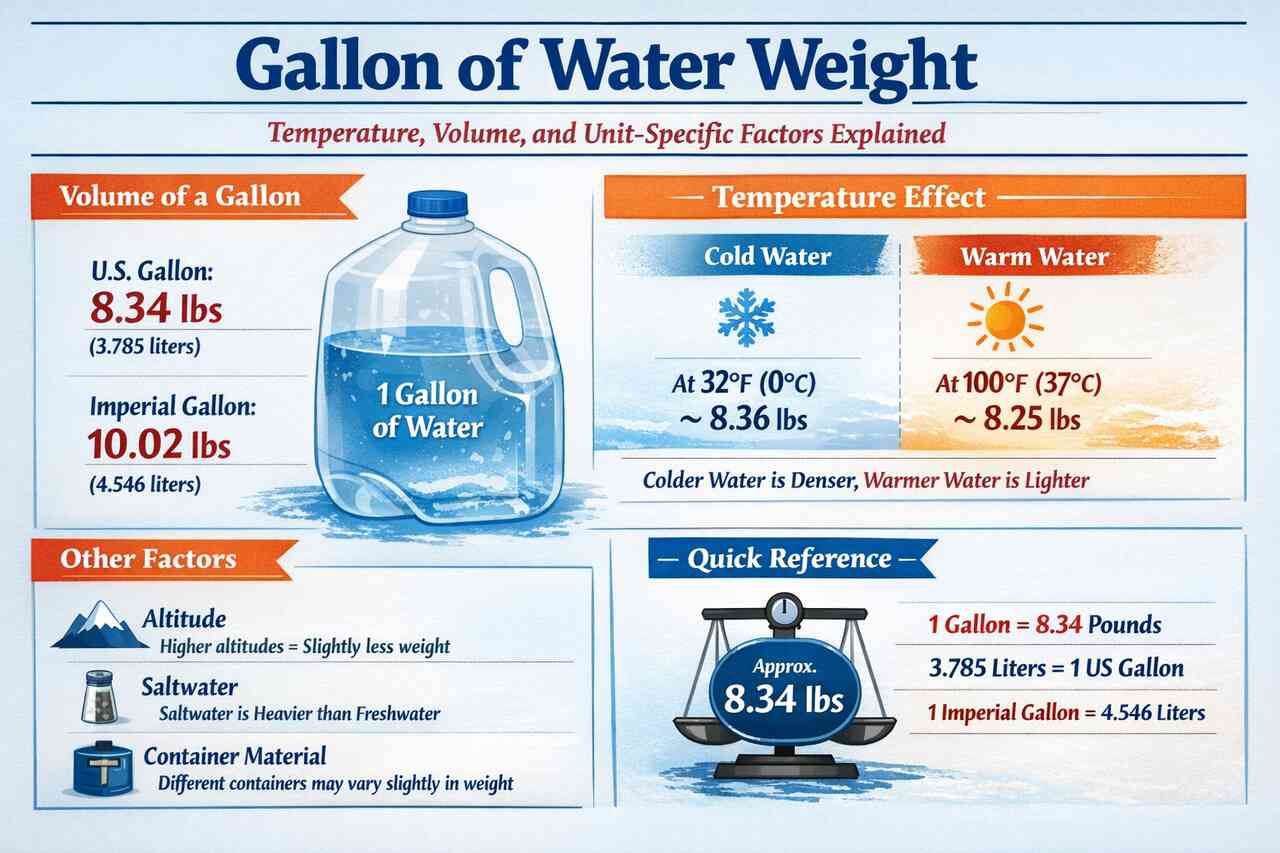
A gallon of water weighs 8.34 pounds (lbs) at 62°F (17°C) under standard atmospheric pressure. This measurement is specific to U.S. liquid gallons, which are different from Imperial gallons or dry gallons. The weight varies with temperature, measurement system, and purity level of the water.
Why Does Water Weight Change with Temperature?
Thermal expansion causes water density to vary with temperature. As temperature increases, molecular activity intensifies, resulting in lower density and reduced weight per volume unit. At 32°F (0°C), water is denser, and a gallon weighs slightly more than at room temperature. Conversely, at 100°F (38°C), water becomes less dense and weighs slightly less per gallon.
Scientific Principle: Water’s density (ρ) is a temperature-dependent variable, directly influencing its weight (Weight = Volume × Density).
Entities involved: Density, Temperature, Volume, Specific Gravity.
How Do Different Gallon Types Affect Water Weight?
-
U.S. Liquid Gallon: Weighs 8.34 lbs at 62°F. Defined as 128 fluid ounces or 3.785 liters.
-
Imperial Gallon (UK): Weighs approximately 10.02 lbs, equivalent to 4.546 liters.
-
U.S. Dry Gallon: Rarely used for liquids, equates to about 9.71 lbs, based on a volume of 4.405 liters.
Conversion Factors:
1 liter = 2.20462 lbs (approx., depending on temperature)
1 gallon (US) = 3.78541 liters
Entities: Imperial System, Metric System, Volume Unit, Mass.
How Do Purity and Salinity Impact Water Weight?
Pure distilled water is used for standard weight calculations. Mineral content, dissolved salts, or contaminants increase density and weight per gallon. For example:
-
Seawater (with salinity around 35 ppt) weighs about 8.6 lbs per gallon.
-
Hard water with high calcium or magnesium ions slightly exceeds 8.34 lbs per gallon.
Semantic Link: Increased solute concentration → Higher mass per volume → Higher gallon weight
Entities: Salinity, Solute Concentration, Total Dissolved Solids (TDS), Density.
What Is the Scientific Basis for Calculating Water Weight?
The equation Weight = Volume × Density governs the measurement.
At standard temperature and pressure (STP), water’s density is approximately 0.998 g/cm³ or 998 kg/m³. When applied to a U.S. gallon (3.78541 liters), the resulting mass is about 3.78541 kg, or 8.345 lbs after converting kilograms to pounds.
Additional Factors:
-
Atmospheric pressure can slightly affect density.
-
Gravity variations (altitude or latitude-based) can cause micro-differences.
Entities: Density (ρ), Volume (V), Weight (W), Gravitational Constant (g).
What Practical Applications Rely on Knowing Gallon Water Weight?
-
Shipping and Logistics: Weight calculation for liquid cargo.
-
HVAC and Plumbing Systems: Accurate flow rates and load calculations depend on fluid weight.
-
Nutrition & Hydration: Medical fields and athletes use precise water weight to measure intake.
-
Agriculture and Irrigation: Efficient water distribution requires volume-to-weight conversions.
Entities: Load Capacity, Flow Rate, Medical Dosage, Irrigation Volume, Fuel-Water Equivalence.
Conclusion:
The question “how much does a gallon of water weigh” connects physical science with real-world usage. The standard answer—8.34 lbs—is context-sensitive, depending on temperature, measurement system, and purity. Precision in water weight supports engineering, medical, and environmental applications across industries.
Read Next: Top Space-Saving Gadgets for Small Homes & Apartments


